

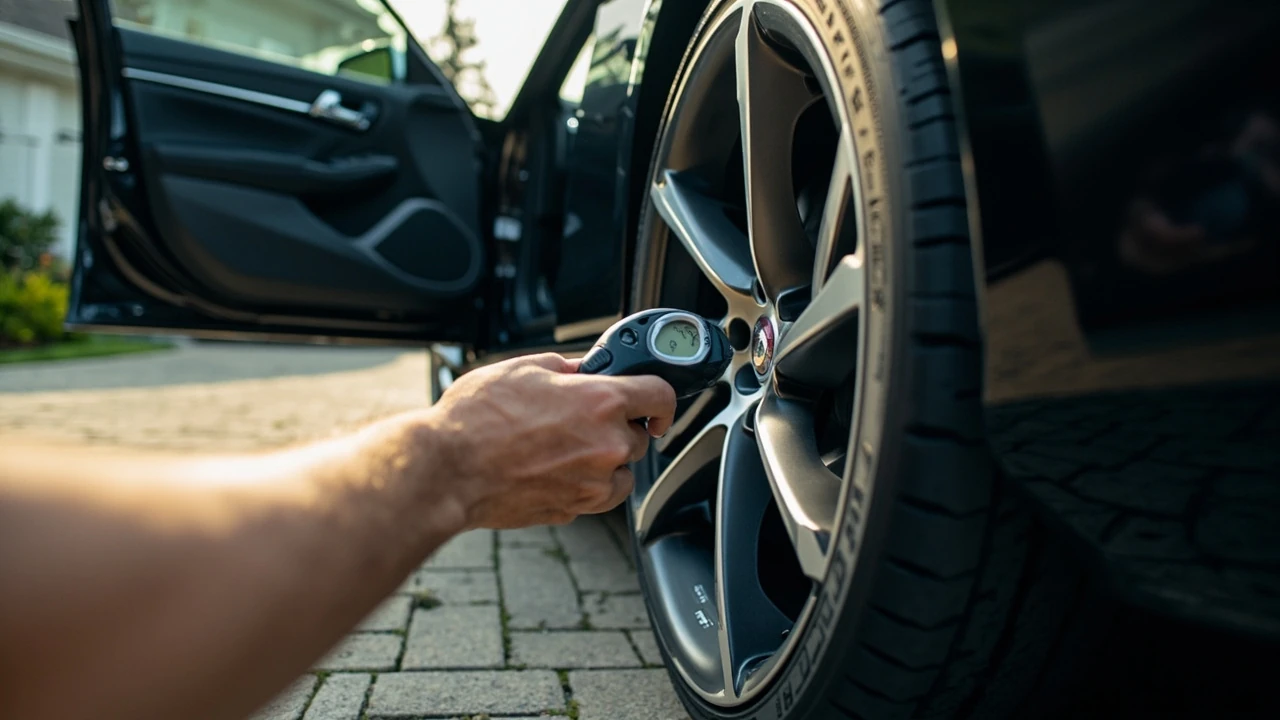
What should tire pressure be? Use the door-jamb placard
What should tire pressure be is a question best answered with the number printed on the placard inside your driver’s door jamb, not with a general rule of thumb. Check that label when the tires are cold, compare each reading with the pressure specified for the front and rear axles, and adjust any tire that falls below its target. The placard also provides the correct units and may list separate pressures for a full load or other operating conditions.
A tire’s sidewall contains useful information, but the maximum pressure molded into the rubber is not the recommended daily setting. Likewise, the warning threshold in a tire-pressure monitoring system is not the target you should use when inflating tires. A vehicle may still handle poorly, wear its tread faster, or lose fuel economy before the TPMS light comes on.
The safest process starts with identifying the correct vehicle specification. Then measure the tires under consistent conditions, understand why readings change, and make small adjustments based on the manufacturer’s guidance rather than on an arbitrary number.
| Location | What it tells you | How to use it |
|---|---|---|
| Driver’s door-jamb placard | Recommended cold tire pressure, usually stated in PSI, and any axle-specific or load-specific values | Use this as the primary target for normal driving |
| Owner’s manual | Detailed explanations, special load recommendations, TPMS information, and procedures for checking tires | Consult it when the placard is missing, worn, or does not cover your situation |
| Tire sidewall | Construction details, tire size, load and speed ratings, and often a maximum cold inflation pressure | Use for tire identification; do not treat the maximum as the normal target |
| TPMS display | A warning when a monitored tire is substantially below its specified pressure | Use it as a warning, then verify and inflate with a gauge |
How to find the correct PSI for your car
The correct pressure is vehicle-specific. A compact car, pickup truck, crossover, and performance model may use different figures even when their tires appear similar. The driver’s door-jamb placard is the most direct source because it applies to the vehicle, its axle arrangement, and the load condition for which the listed pressures were established.
Start by opening the driver’s door and looking along the door frame, latch area, or lower rear edge of the door opening. The placard is usually a rectangular label with tire information and a diagram. Depending on the vehicle, it may list one pressure for the front and rear, separate front and rear figures, or a normal-load value plus a full-load value.
Record the PSI figures exactly as shown, including any notes about which tire goes where. If the label lists an option for a full load, use the normal-load recommendation for ordinary passenger use. Use the full-load figure when the vehicle is carrying people or cargo near the limit described by the manufacturer. Do not add the normal and full-load pressures together, and do not average the front and rear recommendations.
The units may be PSI, meaning pounds per square inch. Some vehicles display kilopascals or bar instead. If the placard uses a different unit from your gauge, convert it carefully or use a gauge that can display the required unit. A driver who knows only the maximum pressure printed on a tire may set all four tires too high and reduce the traction available on a wet road.
If the placard is illegible or missing, check the owner’s manual before estimating a pressure. A replacement tire’s sidewall, the vehicle model alone, and the pressures of nearby cars are not reliable substitutes. If the correct specification cannot be confirmed, have a qualified tire professional identify it from the vehicle identification information and manufacturer records.
| Label or number | What it means | Should it be your inflation target? |
|---|---|---|
| Door-jamb recommended cold PSI | The vehicle maker’s specified pressure for the applicable axle and load condition | Yes |
| Sidewall maximum cold PSI | The highest pressure the tire is designed to carry under specified test conditions | No, unless the vehicle manufacturer specifically directs you to that value |
| TPMS low-pressure threshold | The point at which the monitoring system should issue a warning | No; it is normally below the recommended placard pressure |
| Pressure of another tire on the same vehicle | May reveal a leak if the tires should be equal | No; use the placard as the target |
How to check and adjust tire pressure correctly
For the most accurate reading, check the tires when they are cold. Cold generally means the vehicle has been parked for at least a few hours or driven no more than a short distance at low speed. If the car has just been driven, the tires may be warmer than the surrounding air, and their pressure will have increased. That does not necessarily mean the tires were overinflated when you started the trip.
Use a dependable gauge rather than estimating by feel. A pencil-style gauge may be adequate for occasional use, but a digital gauge with a clear display is easier to read and often less prone to viewing-angle errors. Check whether the gauge appears damaged, and compare it with another gauge if a reading seems unusually high or low.
Here is a practical sequence for checking and correcting pressure:
- Park on level ground, engage the parking brake, and place wheel chocks behind a wheel if needed.
- Open the driver’s door and identify the placard pressure for the front and rear axles.
- Check the valve stem on each tire and remove the valve cap.
- Press the gauge straight onto the valve, listen for a brief air release, and read the display without pressing the valve stem.
- Compare each reading with the correct placard value for that tire’s position.
- Add air to a low tire in short bursts, rechecking after each addition.
- Release air from an overinflated tire as needed, then check it again because some gauges briefly show pressure that has not fully settled.
- Replace the valve caps and confirm all four readings again.
Do not use soap, water, or an improvised leak solution around an electronic TPMS sensor, and do not push a gauge forcefully onto the valve. A damaged sensor or valve can cause a slow leak even when the tire itself holds air. If a tire repeatedly loses pressure, inspect it before repeatedly adding air. A visible puncture, embedded object, damaged bead, or valve leak needs attention rather than repeated inflation.
Use the vehicle placard as the standard even if every tire shows the same pressure. Equal readings can be equally incorrect. This is especially true when a tire has been changed, when a spare is installed, or when a tire has been overinflated for a long period.
Why hot tires show a higher pressure
Tire pressure changes as the air inside warms and cools. As the vehicle moves, flexing, friction, and heat raise the temperature of the tire. The pressure rises with that heat even though the amount of air inside has not changed. When the vehicle sits, the heat gradually escapes and the pressure returns closer to its cold value.
That is why a reading taken immediately after highway driving may be several PSI higher than the placard value. If you check a warm tire and inflate it to the cold target, you can leave the tire with extra pressure once it cools. If a shop checks warm tires before a long drive, it may release air so the tires reach the target after cooling.
A useful approach is to check the cold pressure first, add enough air to reach the placard value, and then recheck the tires after driving if the vehicle’s operating procedure calls for it. Do not bleed air from a warm tire simply because its pressure exceeds the cold placard number. If the tire was properly inflated when cold, it should return to approximately that pressure after the heat dissipates.
Understanding For additional context, how a tire-pressure gauge works also helps explain why a reliable instrument matters. Mechanical gauges use a moving element connected to a scale, while digital gauges convert a pressure signal into a numeric display. Common consumer gauges are accurate within a few PSI, so a small difference between the placard and the gauge may reflect the instrument as well as the tire. Always follow the vehicle specification, but check a questionable gauge if readings vary unexpectedly.
Should front and rear tires have the same pressure?
Not necessarily. The For additional context, placard may prescribe the same pressure for all four tires, but many vehicles use different front and rear values for handling, load distribution, or axle design. Use the number listed for the tire’s actual position. A rear tire should not be set to the front specification merely because the driver is inflating the tires in one pass.
Consider this hypothetical placard rather than a real vehicle specification:
| Tire position | Placard value | Correct action |
|---|---|---|
| Front left | 34 PSI cold | Inflate to 34 PSI when cold |
| Front right | 34 PSI cold | Inflate to 34 PSI when cold |
| Rear left | 36 PSI cold | Inflate to 36 PSI when cold |
| Rear right | 36 PSI cold | Inflate to 36 PSI when cold |
This example shows why matching all four readings may not be the correct goal. Matching the correct specification is the goal. The example is illustrative and should not be applied to another vehicle without checking its own placard.
Payload can matter as well. If the placard provides separate recommendations for normal and full-load conditions, choose the relevant one. Extra passengers or cargo can change how the vehicle sits, how much weight reaches the rear axle, and how the tires should be inflated. If you are unsure which load condition applies, consult the placard wording and the owner’s manual rather than guessing.
Do not compensate for a heavy load by inflating only the visibly low tire. Set all four tires to the applicable target, then recheck them. Uneven readings should still be investigated because they may indicate a leak, a tire that was not measured correctly, or damage.
How low tire pressure affects handling, wear, and safety
Underinflation changes the shape in which a tire meets the road. A low tire can flex more than intended, leading to heat buildup and irregular wear across the tread. It may also reduce steering response, increase rolling resistance, and make the vehicle more difficult to control if a pothole or wet patch reduces available grip. Severe underinflation can cause visible damage or tire failure.
Overinflation is not a substitute for good tire condition. A tire inflated above its appropriate value may have a smaller contact patch, sharper response to steering inputs, and less ability to absorb impact. Uneven shoulder wear can develop, and the tire may be more vulnerable to damage from curbs and road hazards. The sidewall’s maximum pressure is a limit, not an everyday recommendation.
Watch for these warning signs:
- A tire that looks noticeably flatter than the others when the vehicle is parked
- Uneven tread wear, such as excessive wear on one shoulder or across the center
- Increased rolling resistance or a change in fuel economy
- More pronounced bouncing, vibration, or road noise
- A TPMS warning light or a message reporting a tire pressure problem
- A tire that repeatedly loses air after being inflated
These signs are not unique to pressure problems. Tires can wear unevenly because of alignment, suspension, or loading conditions, and a TPMS warning can also result from a dead sensor battery or interference. If steering feels unusually difficult, review our guide to why a steering wheel may be hard to turn before assuming low pressure is the only cause.
The tire-pressure monitoring system is a useful warning tool, but it is not a substitute for a gauge. Modern systems can read all four pressures through sensors, while indirect systems infer pressure from differences in wheel speed. Neither approach makes it necessary to skip regular manual checks. The system may warn after pressure has already fallen materially below the specified value.
What a TPMS warning means and what to do next
A TPMS warning is not an instruction to fill the tire to the highest pressure printed on its sidewall. It means that the system has detected a condition it considers abnormal, commonly a substantial pressure loss, though the exact cause can vary. The correct response is to check all four tires with a gauge, identify the appropriate placard values, and inspect for a visible reason the pressure is low.
Before driving far, inspect the tire at the lowest point and around the tread. Look for a nail, screw, glass, cut, bulge, or separated tread. If the tire is visibly damaged or substantially low, do not assume that adding air will make it safe. Install the spare or use roadside assistance according to the owner’s manual if the tire cannot be safely driven.
After checking and correcting pressure, the warning may clear only after the vehicle has been driven for a short period or reset according to the manufacturer’s procedure. If the light returns, a slow leak, damaged valve, aging sensor, or another fault may be present. A shop can distinguish an inflation problem from an equipment problem.
Do not confuse the TPMS symbol with unrelated dashboard warnings. For example, a battery indicator is a separate electrical issue described in battery light on but car runs fine. Identifying the exact symbol matters because the correct response to a low-pressure warning is completely different from diagnosing an electrical fault.
Official For additional context, vehicle tire-safety guidance provides additional information about maintaining tires and responding to pressure warnings. Use the vehicle-specific instructions in your owner’s manual whenever they differ from general guidance.
When to check pressure and how to prevent recurring losses
Check tire pressure monthly and before long trips. Also inspect the tires whenever you notice a visual difference, a TPMS warning, unusual wear, or a tire that appears to have lost shape. A scheduled check is more useful than waiting for a warning because underinflation can develop gradually and remain unnoticed.
For the most useful monthly routine:
- Compare all four readings with the placard before adding air.
- Record each cold measurement so gradual changes become easier to notice.
- Inspect tread, sidewalls, valve stems, and the space around each tire for visible damage.
- Check whether all four tires, including the spare, meet their applicable specifications.
- Investigate any tire that is more than a small amount below its target or loses air repeatedly.
Some drivers keep an inexpensive gauge in the trunk and check before fuel stops. Others rely on a TPMS. Neither approach should replace the other. A TPMS may not report a pressure that is low enough to damage the tire but still high enough to affect fuel economy or wear. A manual gauge provides a direct reading and lets you compare every tire with its proper target.
Small differences between tires are not automatically a leak. Check the placard to see whether different values are expected, and verify the measurement with the same gauge on each tire. A larger or repeating difference deserves closer attention. Before assuming that every tire should be identical, make sure none has been overinflated to compensate for a slow leak.
If a tire repeatedly loses air, first correct the pressure and monitor it. Then have the tire inspected for punctures, valve damage, bead problems, and sidewall damage. If a tire looks sound but still loses air, a controlled leak test may be needed to locate the problem. Replacing the entire tire is not always necessary, and repeatedly adding air does not repair a leak.
Because tire condition changes with mileage, age, exposure, and use, do not assume the first correct reading remains correct forever. Recheck according to the manufacturer’s schedule and after any event that could damage a tire, such as a pothole, curb strike, or underbody impact.
Frequently asked questions
What pressure should I put in my tires?
Put in the cold tire pressure specified for each axle on the driver’s door-jamb placard. Use the value that applies to your normal or full load condition. Measure the tires before driving when they are cold, and do not use the maximum pressure printed on the sidewall as the target unless the vehicle manufacturer specifically directs you to do so.
How do I find the correct PSI without the placard?
Check the owner’s manual or have a tire professional look up the vehicle specification using the year, make, model, and trim. Do not rely on the maximum pressure on the tire, the pressure in another vehicle, or an internet formula based only on tire size. Different vehicles can require different pressures even with similar-looking tires.
Should I check tire pressure when the tires are hot?
You can check warm tires for obvious leaks or a severe low-pressure condition, but the placard specifies cold pressure. If a tire is hot and above the cold target, it may be correctly inflated. Add air only when needed, and let the vehicle sit before making a precise adjustment if you want to match the cold specification exactly.
Why is my tire pressure higher after driving?
Driving creates heat through tire flexing and road friction. That heat raises the air pressure inside the tire without necessarily adding air. After the vehicle has rested and the tires have cooled, the reading should move closer to the placard value. Bleeding warm tires down to the cold target can leave them underinflated once they cool.
Do front and rear tires need the same pressure?
They need the pressure specified for their positions. Some placards list one value for all four tires, while others list different front and rear values. Read the placard carefully and check each tire against the correct figure. Do not average the values or assume that all four must display the same number.
How often should I check my tire pressure?
Check at least monthly, before long trips, and whenever you notice a warning, visual irregularity, or change in handling. More frequent checks are useful on vehicles that lose air, travel on rough roads, carry changing loads, or have aging tires. Record the readings so gradual pressure loss is easier to detect.
Is the PSI on the tire sidewall the pressure I should use?
Usually not. The sidewall’s maximum cold inflation pressure indicates the tire’s limit under defined conditions, while the door-jamb placard gives the normal operating recommendation for the vehicle. If the two differ, follow the vehicle specification unless the tire’s manufacturer or vehicle maker directs otherwise.
Can I drive with a TPMS light on?
Check and inflate the tires as soon as practical. If a tire is visibly low, damaged, bulging, or has a serious puncture, do not continue driving on it; use the spare or roadside assistance as directed by the owner’s manual. If all readings are correct but the warning remains, have the TPMS system inspected because a sensor or system fault may be responsible.
Why does one tire keep losing air?
A slow leak, valve damage, embedded object, or puncture may be responsible. Check the tire cold, inflate it to the placard value, and monitor it for further loss. Repeatedly adding air is temporary maintenance, not a repair. A tire shop can perform a controlled leak test and inspect the tire, valve, and wheel before recommending another step.


Leave a Reply