

Coolant in Oil: What It Means and What to Do
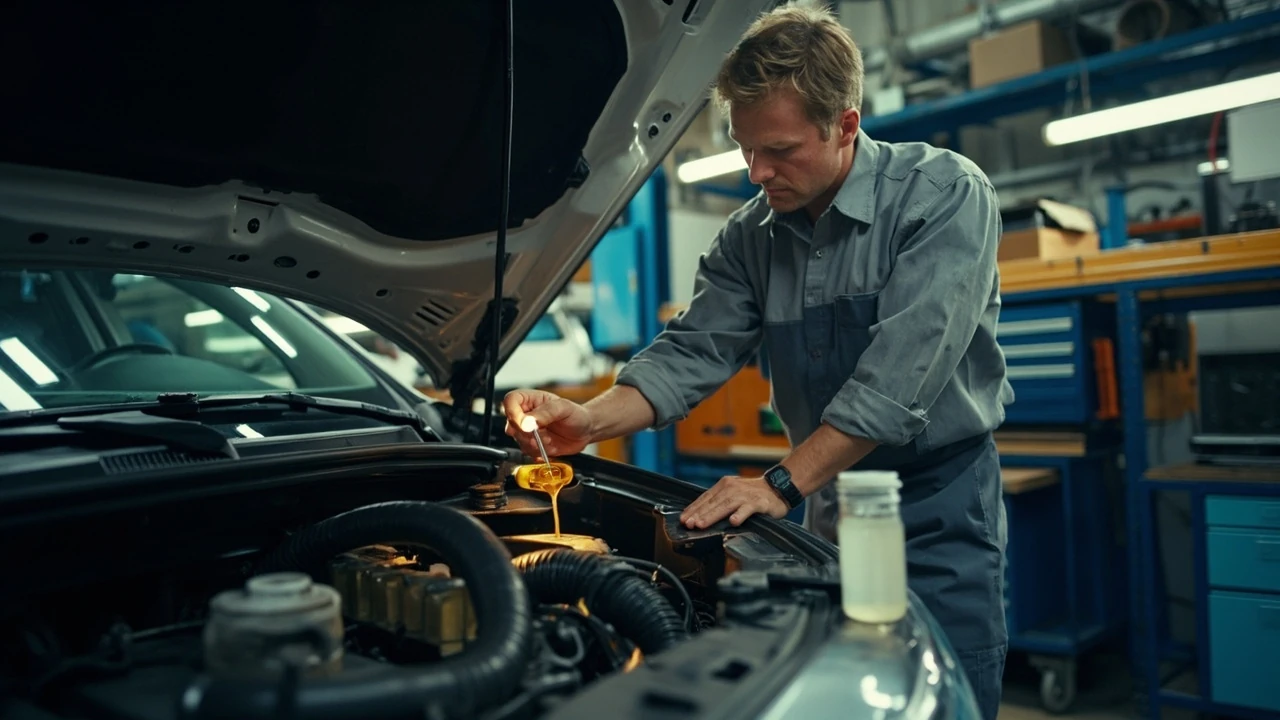
Finding coolant in oil turns a routine oil change into a potential engine emergency. The oily residue may look milky, foamy, or unusually light-colored, and the engine oil may smell sweet or show a high coolant level after a refill. Those clues can indicate that engine coolant has entered the crankcase through a failed head gasket, a cracked cylinder head or engine block, or a damaged oil cooler.
The correct response depends on how the car is operating. A vehicle that is overheating, losing oil pressure, making metallic noises, or producing thick exhaust smoke should not be driven to a shop. If the engine is cool and the symptoms are limited to contaminated oil, a tow or cautious road test may be reasonable after a professional assessment. Diagnosing the contamination is only the first step; the cause must be found before the vehicle can be repaired reliably.
This guide explains the common causes, warning signs, diagnostic sequence, repair options, and questions to ask a repair shop. It also explains why adding more oil or coolant is not a fix and why a simple oil change rarely solves the underlying problem.
| What you notice | What it may indicate | Immediate action |
|---|---|---|
| Milky residue on the dipstick or oil filler cap | Coolant may have mixed with the crankcase oil | Stop driving and arrange inspection |
| Sweet chemical smell near the engine | Coolant may be leaking into hot oil or combustion areas | Do not run the engine at high load |
| Foamy residue under the oil cap | Oil may be aerated by a crankcase leak or other mechanical issue | Check oil level and oil-pressure warnings |
| Overheating, low oil pressure, or a warning light | Cooling-system damage may now be affecting the engine | Stop the vehicle safely and arrange a tow |
| Low coolant level with no visible external leak | Internal leakage or a cooling-system failure may be present | Do not assume the radiator cap is faulty |
Why coolant mixes with engine oil
An engine’s lubrication and cooling systems normally remain separate. Oil circulates through the crankcase, cylinder walls, bearings, and other lubricated surfaces. Coolant flows through the cylinder head, engine block, radiator, heater core, and connecting pipes. A gasket, sealing surface, or metal component must fail for those two fluids to meet.
The most familiar route is a head gasket failure. This gasket seals coolant passages against oil passages and combustion pressure. If it cracks or burns through, coolant can travel into a cylinder, an oil passage, or the crankcase. Combustion pressure can force coolant outward under load, while a vacuum or oil-pump suction can draw fluid inward when the engine cools or idles.
A cracked cylinder head or engine block can create a similar problem. Cracks may follow overheating, corrosion, a frozen block, or mechanical stress. Even a small crack can connect a coolant passage to an oil gallery, though some cracks only leak under specific operating conditions.
An oil cooler is another possible route. Vehicles with engine oil coolers may route coolant through a heat exchanger that sits in the oil supply. A failed cooler or its seals can allow coolant into the oil or oil into the cooling system. A transmission cooler can create another shared circuit in some vehicles, particularly when the transmission fluid and engine oil travel through closely related passages. The exact layout depends on the model.
Sometimes the appearance is misleading. Emulsified oil can also result from excessive moisture, coolant additives mixed with oil, or a problem that allows air and moisture into the crankcase. Oil aeration can create foam, but true coolant contamination generally changes the oil’s color, smell, level behavior, or chemical properties more substantially.
It is also important to distinguish coolant in oil from oil in coolant. Oil in coolant usually appears as a slick film, dark oily residue, or oil-based sludge in the radiator or coolant reservoir. It does not automatically prove that the head gasket has failed, although it can occur with the same kinds of internal failures. Conversely, a milky oil sample should not be dismissed as ordinary condensation if it contains a meaningful amount of coolant.
Common causes to investigate
- Burned or cracked head gasket: Often linked to overheating, coolant loss, detonation, corrosion, or a frozen cooling system.
- Cracked cylinder head: A thermal crack may open only under certain temperatures or operating loads.
- Cracked engine block: Less common than head-gasket damage, but possible after severe overheating or a mechanical failure.
- Failed oil cooler or cooler seal: A damaged heat exchanger can mix the oil and coolant circuits.
- Coolant-system sealing failure: A failed gasket, O-ring, or fitting may leak coolant into an adjacent oil passage.
- Oil aeration or additive reaction: These conditions can imitate contamination and should be separated from a true internal leak during testing.
Warning signs that deserve immediate attention
The clearest warning sign is a change in the oil itself. Conventional engine oil is amber to dark brown depending on its age and type. Fresh oil that suddenly looks tan, gray, or milky, especially when the dipstick shows residue above the normal range, should be treated as contaminated until tested.
A coolant smell is another strong clue. Some coolant formulations have a sweet or chemical odor, though a smell alone cannot confirm the source. Check whether the odor becomes stronger near the oil filler, when the engine warms, or after adding coolant to a low reservoir. Do not spray cleaner or a flammable liquid into the engine bay to identify the odor, and do not remove the radiator or coolant cap while the system is hot.
Other signs depend on where the leak occurs. Coolant entering a cylinder can cause persistent white exhaust vapor, a cold engine that warms unevenly, and a temperature gauge that behaves strangely. A leak into an oil gallery can reduce lubrication, leading to a low oil-pressure warning, a flashing oil-pressure light, knocking, or metallic impact sounds. If those symptoms appear, continued running risks bearing, rod, and piston damage.
Keep an eye on the coolant reservoir and the engine oil level between inspections. If the oil level rises without a normal oil change, suspect coolant entry. If the coolant level drops while the oil level remains stable, suspect leakage into the cooling circuit or an external coolant leak. Neither trend identifies the exact component, but both justify testing.
Do not ignore these signs
- A red oil-pressure warning that stays on with the engine running
- A temperature gauge in the red zone or an overheating warning
- Metallic knocking, grinding, or a sudden change in engine sound
- Dense white exhaust, repeated bubbling in an open radiator, or a strong fuel odor
- Oil that rapidly returns to a high level on the dipstick
- Repeated low coolant warnings despite no visible external leak
Is it safe to keep driving with coolant in oil?
It may be possible to move a vehicle only after confirming that the engine retains oil pressure, does not overheat, and has no serious internal noise. That does not mean driving is risk-free. Contaminated oil can lose viscosity, and a failed gasket may allow additional coolant to enter the engine with every start. Road heat, traffic, towing a trailer, and sustained high engine speed can turn a marginal condition into a seized engine or damaged connecting rod.
Stop the engine immediately if the oil-pressure light comes on, the temperature climbs into the warning zone, the engine starts knocking, or the oil level becomes too low to read accurately. If the oil cannot reach the pump, continuing to idle may still cause damage.
For a vehicle that starts normally, holds a stable temperature, and shows no oil-pressure warning, a short direct drive to a repair facility may be reasonable. Keep the trip short, avoid hard acceleration, watch the temperature gauge, and do not add coolant to a hot engine. If the situation is uncertain, towing is cheaper than replacing an engine that has lost lubrication.
Do not try to dilute the contamination. Some owners add fresh oil to lower the coolant percentage, but that only changes the visible ratio. It does not remove coolant from the crankcase, repair the leak, or restore the oil’s intended viscosity. Likewise, adding oil to the cooling system is not a valid operating strategy. Both actions can make later diagnosis harder and may introduce additional problems.
How a technician diagnoses the cause
A proper diagnosis follows a sequence. The technician first confirms that the fluid is actually mixed, then identifies the leak path, checks the condition of the engine, and estimates whether the engine can be repaired economically. The order matters because replacing the oil without finding the source only resets the clock until the coolant returns.
Step 1: Confirm the condition
The technician inspects the oil dipstick, filler cap, coolant reservoir, radiator, and oil-fill area. If the oil is milky, the vehicle may need an oil sample or laboratory analysis. Testing can distinguish coolant, water, fuel, and additive-related emulsification. A coolant concentration measurement may also be performed.
Visual inspection of the open engine bay can reveal cracked hoses, leaking fittings, an oil cooler, or signs of a recent overheat. Some leaks are external and easy to see, but an internal failure may leave no visible evidence. A pressure test may check the cooling system, although some engine designs make complete pressurization difficult.
Step 2: Check the oil system
Oil pressure should be tested at idle and at the specified engine speed. The technician also checks for aeration, foaming, low oil level, or oil that has lost viscosity. A low-pressure result can confirm that the lubrication system is no longer safe, even if the engine still sounds normal.
Oil filters, oil coolers, and oil lines are inspected for damage. On engines with a separate oil cooler, isolating the cooler may show whether it is allowing coolant to enter the oil circuit. This testing must be performed carefully because the oil system still needs lubrication while the suspected component is bypassed.
Step 3: Test for combustion-gas leakage
A cooling system that holds pressure but loses coolant may have an internal leak. A compression test can reveal a cylinder with low compression, and a leak-down test can help identify where escaping air is going. A borescope inspection may show coolant inside a cylinder or damaged valving. These results support the diagnosis but do not always identify the failed part by themselves.
Combustion gas testing is another useful method. Exhaust gas can enter the cooling system through a damaged head gasket even when no obvious bubble appears in the radiator. The technician may use dye, a combustion-gas detector, or pressure tests to determine the source. No single test is universal because the best method depends on the engine’s design.
| Diagnostic finding | Possible interpretation | What it does not prove |
|---|---|---|
| Milky dipstick and confirmed coolant in the oil sample | Internal fluid transfer is likely | Does not identify whether the head gasket, head, block, or cooler failed |
| Combustion gas present in the cooling system | A combustion-to-cooling leak may exist | Does not automatically confirm a head gasket failure |
| Coolant found inside a cylinder | One or more cylinder-head sealing surfaces may be damaged | Does not establish that the engine block is reusable |
| Oil cooler isolated and contamination stops | The oil cooler or its seals are strongly implicated | Does not rule out a second fault elsewhere |
| Oil pressure falls during the test | The lubrication supply may be inadequate | Does not distinguish contamination from other pump or bearing problems |
Head gasket failure and other causes compared
A head gasket failure is a common explanation, but it should not be treated as the only possibility. The evidence matters because the repair scope can change significantly. A failed oil cooler seal may require removing and replacing a heat exchanger, while a cracked block can mean the engine cannot be safely rebuilt.
A head gasket failure may be primary or secondary. A primary failure occurs first, often because of a cooling-system defect, detonation, overheat, corrosion, or an improper installation. A secondary failure occurs after another fault has already caused the engine to overheat. In a secondary failure, the damaged head or block may no longer be serviceable, and replacing only the gasket may not restore reliability.
Common cooling-system causes include a failed fan, an inoperative fan clutch or electric fan, a stuck thermostat, a collapsed radiator hose, a faulty water pump, low coolant, or an incorrect coolant mixture. These conditions may produce obvious warnings before gasket damage occurs. A cooling system that still loses coolant after the obvious faults are corrected deserves a careful internal inspection.
An oil cooler failure may involve a cracked cooler core, degraded seals, or an O-ring at the coolant-to-oil interface. The repair can be simpler than a head gasket replacement, but the cooler and its seals must be tested correctly. Similar reasoning applies to transmission coolers and shared heat exchangers.
Questions that help separate the causes
- Did the engine overheat, lose coolant suddenly, or show a temperature warning before the oil changed?
- Was there a recent cooling-system repair, coolant service, or engine repair?
- Is coolant present in a cylinder, an oil passage, or both?
- Did the oil remain at normal pressure, and did testing point to an oil cooler?
- Is there visible cracking, corrosion, warping, or combustion damage on the head or block?
- Did the failure follow an impact, flood, freeze, or engine malfunction?
What repair options may cost and involve
The repair depends on the failed component and the engine’s condition. A shop should provide a written diagnosis, the replacement parts, the labor involved, and any additional work that can be justified by the inspection. A low estimate based only on replacing the head gasket is incomplete if the head, block, pistons, bearings, or cooling-system components also show damage.
When the head gasket is the only confirmed problem, the repair commonly includes removing the engine head, inspecting the head and block, replacing the gasket, checking the cylinder head bolts and their specified torque procedures, and verifying the cooling and oil systems. Some engines use stretch bolts or a torque-angle sequence that requires specialized procedures and accurate measurement.
If the head is cracked, warped, or damaged by heat, it may need replacement. If the block is cracked, replacement may be required. A seized engine, damaged bearings, scored cylinder walls, or a collapsed valve can turn a gasket repair into a much larger project. These are among the reasons an engine inspection during teardown matters.
An oil cooler failure generally requires removal or isolation of the cooler, inspection of the associated seals and passages, and replacement of damaged components. The engine oil, filter, and any contaminated coolant must also be replaced. Flushing the cooling system may be appropriate, but the procedure should follow the manufacturer’s instructions.
Owners should ask whether the estimate includes:
- The diagnostic labor used to locate the leak
- The failed gasket, head, block, cooler, seals, or other specific components
- Engine oil, filter, coolant, and other required fluids
- Inspection of adjacent parts and surfaces
- A cooling-system pressure test and verification of fan operation
- A road test, temperature check, and oil-level inspection after reassembly
Used engines, rebuilt engines, and lower-cost repair options may be available, but they carry different warranties, labor risks, and uncertainties. The cheapest quote is not necessarily the best value if the shop cannot clearly identify the cause or does not explain which components are being replaced.
What to do after the repair
After the leaking component is repaired, the cooling and lubrication systems must be refilled with the correct fluids. Coolant type matters. Many modern engines require a specific chemical formulation, and mixing incompatible products can reduce corrosion protection or damage seals. The repair manual and coolant container markings should guide the selection.
The old engine oil and filter should be replaced because they may contain coolant, metal particles, or wear debris. The filter may need special attention if the engine has suffered a low-lubrication event. The technician should check for coolant in the replacement oil, verify oil pressure, bleed air from the cooling system as required, and confirm that the heater and climate controls operate normally.
A post-repair check should include a warm-up cycle, confirmation of stable engine temperature, an oil-level inspection after the engine has settled, and a review for new leaks. If the vehicle previously overheated, the cause of the original overheat must also be corrected. Replacing a head gasket without replacing a failed radiator fan, for example, may leave the same failure ready to happen again.
Drivers should watch the temperature gauge, coolant reservoir, and oil dipstick during the first several drives. A small oil-level increase can occur through normal oil consumption in some engines, but a rapid rise should be investigated. Any return of milky oil, sweet odor, pressure warning, or overheating indication means the vehicle should be inspected promptly.
Preventive maintenance can reduce the risk of repeat failure, but no service schedule can compensate for a cooling-system fault left unresolved. Keeping the coolant at the proper level, using the specified coolant, replacing deteriorated hoses, and ensuring that the fan operates promptly all support reliable temperature control.
Frequently asked questions
Can coolant in oil damage the engine?
Yes. Coolant can reduce the oil’s ability to protect and lubricate engine components. If the engine runs with contaminated oil, bearings, pistons, rods, and cylinder walls may wear or fail. The severity depends on the amount of contamination, how long the vehicle ran, and whether oil pressure remained adequate. Continuing to drive after an oil-pressure warning or overheating event can turn a repairable leak into an engine replacement.
Does coolant in oil always mean the head gasket is bad?
No. A damaged head gasket is a common cause, but coolant can also enter the oil through a cracked cylinder head, cracked engine block, failed oil cooler, damaged seal, or nearby fitting. Testing is needed to find the leak path. Replacing the head gasket without confirming the source may leave the original fault in place.
Can I just change the oil and keep driving?
An oil change can remove the contaminated oil, but it does not repair the leak. If the engine is cold, starts normally, retains proper oil pressure, and does not overheat, a short trip to a repair shop may be reasonable. Do not drive if there is a low oil-pressure warning, overheating, metallic noise, smoke, or a rapidly changing fluid level. A tow is the safer choice when the condition is uncertain.
Why does the oil look foamy instead of milky?
Foam can form when air enters the oil, when coolant mixes with oil, or when certain additives interact with moisture. The appearance alone cannot identify the cause. Check the dipstick and oil cap in a clean state, note the oil color and smell, and have the oil sampled or tested. Repeated foaming after a fresh oil change usually indicates that the underlying problem remains.
Is oil in the coolant the same problem?
It may involve the same internal failures, but the direction of leakage is different. Oil in coolant can appear as a slick film, dark sludge, oily droplets, or a coating in the coolant reservoir. A head gasket, head, block, or shared cooler may be responsible. The technician must trace the oil to its source rather than treating the reservoir appearance as proof of one specific component.
Can a failed oil cooler cause coolant to enter the oil?
Yes. An oil cooler carries coolant through or near the engine’s oil supply. A cracked core or failed seal can allow the fluids to mix. Some designs permit the cooler to be isolated for testing. Repair generally involves replacing the cooler or its failed seals, replacing contaminated fluids, and verifying oil pressure and cooling-system operation.
Should I add coolant to the oil to stop the low-oil warning?
No. Adding coolant to the crankcase can cause foaming, reduce lubrication, and make the diagnosis more confusing. If the oil level is low because coolant has entered and displaced oil, the correct response is to stop running the engine and determine why the oil level is not being maintained. Do not add coolant to an overheated engine, because sudden cooling or pressure changes can cause additional damage.
How long can a car drive with coolant in the oil?
There is no safe general time limit. Even a short drive can allow more coolant to enter, and repeated starts may introduce moisture or gas into the oil. The vehicle is more suitable for a short direct trip only when it starts normally, does not overheat, maintains proper oil pressure, and produces no unusual mechanical noise. Otherwise, stop the engine and arrange a tow.
Will replacing the head gasket solve the problem?
It can solve the problem only if the head gasket is the confirmed failure and the head, block, and surrounding components are serviceable. If the engine overheated, the head may be warped or cracked. If an oil cooler failed, replacing the gasket will not correct that route of leakage. A reliable repair requires identifying the source and inspecting the affected parts before reassembly.
What should I ask the repair shop before approving the work?
Ask for the specific evidence that identified the leak, the parts that will be replaced, the items that will be inspected, and the warranty on the repair. Confirm that the estimate includes required oil, coolant, filter, seals, and testing. If the shop cannot explain how the coolant entered the oil, request a more complete diagnosis before authorizing a major engine repair or replacement.


Leave a Reply