

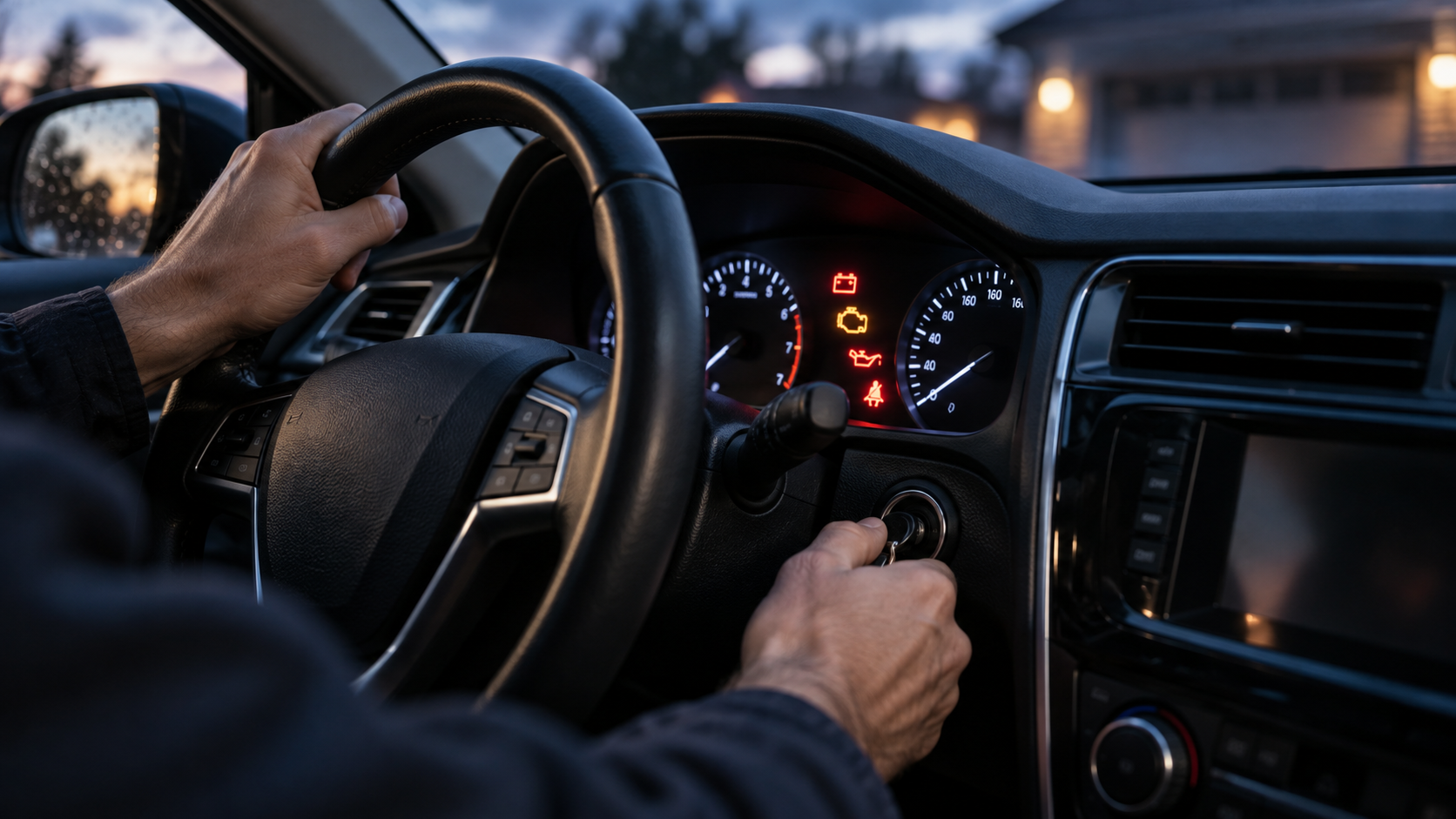
You turn the key or press the start button. The dashboard lights come on. Then instead of the engine starting, you hear a click.
Maybe it’s one solid click. Maybe it’s a rapid click-click-click-click. Or the car clicks once, goes quiet, and acts completely normal again when you stop trying.
If your car clicks when trying to start, the most common causes are a weak or discharged battery, poor battery connections, a failing starter or starter solenoid, or resistance in the main power and ground cables.
But the sound itself matters.
A rapid series of clicks usually points more strongly toward low battery voltage or a poor electrical connection. One heavy click with no engine cranking can point toward the starter circuit, although a weak battery can still cause it.
And here’s the annoying part: your headlights can look perfectly bright while the battery is still too weak to crank the engine.
Starting an engine requires far more electrical current than running dashboard lights or the radio.
Why a Car Clicks Instead of Starting
The starter motor needs a large burst of electrical power from the 12-volt battery.
When you request a start, the starter solenoid moves and connects battery power to the starter motor. The starter then turns the engine fast enough for combustion to begin.
If there isn’t enough current available, the solenoid may engage but the starter won’t turn properly.
That’s where the clicking comes from.
Sometimes the solenoid repeatedly engages and releases because battery voltage collapses under load. You hear rapid clicking.
Other times the solenoid engages once but the starter itself doesn’t spin. You hear one solid click.
Those two sounds give you useful clues before you even open the hood.
What Different Clicking Sounds Usually Mean
| What You Hear | Common Possibility | What Else You May Notice |
|---|---|---|
| Rapid clicking | Weak battery or poor battery connection | Dashboard lights flicker or dim |
| One loud click | Starter, starter solenoid, cable, or battery issue | Lights may stay bright but engine does not crank |
| Click, then everything goes dark | Loose or high-resistance battery connection | Power may return after releasing the key |
| Intermittent single click | Starter or electrical connection problem | Car may start normally on the next attempt |
| Clicking after sitting for days | Discharged battery | Battery may have lost charge while parked |
| Clicking in cold weather | Weak battery exposed by low temperature | Slow or unsuccessful cranking on cold mornings |
Rapid Clicking Usually Points to the Battery
Rapid clicking is one of the classic signs of insufficient electrical power reaching the starter.
Here’s what happens.
The starter solenoid engages. That places a huge electrical load on the battery. Battery voltage suddenly drops too far, so the solenoid releases.
Once it releases, the electrical load disappears and voltage rises again.
The solenoid engages again.
Then voltage drops.
Release. Engage. Release. Engage.
The result is that familiar machine-gun-style clicking noise.
A discharged battery is a very common reason, but don’t jump straight to buying a new one. Loose or corroded terminals can restrict current enough to produce almost the same symptom.
One Click but the Engine Doesn’t Turn
A single heavy click is a little different.
It may mean the starter solenoid is engaging but the starter motor isn’t turning.
Possible reasons include a failing starter motor, worn starter contacts, a mechanical problem inside the starter, weak battery power, or excessive resistance in the cables.
The battery still belongs on the list.
People sometimes hear one click and immediately order a starter. Then the new starter does exactly the same thing because the real problem was a bad battery cable.
It’s better to test than guess.
The Battery Can Look Fine and Still Be Weak
This catches people all the time.
You switch the headlights on and they’re bright. The radio works. The dashboard looks normal. So the battery must be good, right?
Not necessarily.
Lighting and electronics require relatively modest current compared with the starter motor.
A battery can have enough energy to run the dashboard but still fail when asked to deliver several hundred amps for starting.
That’s why a battery load test or conductance test tells you more than simply checking whether the lights work.
Check Battery Voltage Before Replacing Parts
A digital multimeter can provide a useful first clue.
A fully charged conventional 12-volt lead-acid battery that has rested often measures around 12.6 to 12.8 volts.
A reading around 12.4 volts means the battery is partially discharged.
A reading near 12.2 volts is substantially lower, while around 12.0 volts or below indicates a heavily discharged battery.
But resting voltage is only part of the story.
A battery can show 12.6 volts with no load and still collapse when the starter is engaged.
Watching voltage during cranking can reveal that.
Under traditional load-test conditions, around 9.6 volts is often used as a general reference near room temperature, though actual cranking voltage depends on battery type, temperature, starter load, and the vehicle.
Cold Weather Makes Battery Problems Obvious
A battery that seemed perfectly acceptable in September can suddenly struggle on the first freezing morning.
Cold weather reduces the battery’s available starting performance. At the same time, cold engine oil and cold mechanical parts can make the engine harder to turn.
So the battery has less available power exactly when the starter needs more.
That’s why clicking problems often appear during winter even though the battery seemed fine a week earlier.
If your car only clicks on very cold mornings and starts normally after a jump, battery condition should be checked.
Loose Battery Terminals Are Surprisingly Common
Before spending money on a starter or alternator, look at the battery connections.
The battery terminals need to be clean and firmly secured.
A connection can be just loose enough to run lights and accessories but unable to carry the high current demanded by the starter.
You may notice white, blue, or greenish corrosion around the battery posts.
Sometimes the connection looks fine from above, but corrosion is hiding between the terminal clamp and battery post.
A classic clue is this: you attempt to start the engine, hear a click, and all the dashboard lights suddenly disappear.
Then a few seconds later, power mysteriously comes back.
That can happen when a poor connection opens under heavy electrical load.
What You Can Check Before Calling for Help
- Look at the battery terminals for looseness or corrosion.
- Check whether dashboard lights dim sharply when you try to start.
- Listen carefully: one click and rapid clicking suggest different things.
- Try the headlights and notice whether they become very dim during a start attempt.
- Measure battery voltage if you have a multimeter.
- Think about whether the car has been sitting unused for several days or weeks.
- Notice whether the problem appeared after cold weather arrived.
- If safe and appropriate for the vehicle, try a jump start.
Those observations can narrow the problem quickly.
A Jump Start Can Tell You Something
If the car starts normally after receiving a proper jump, low available battery power becomes a strong possibility.
But a successful jump does not automatically prove that the battery itself is bad.
Maybe someone left the interior lights on.
Maybe the vehicle has been parked for a month.
Perhaps the alternator isn’t charging correctly.
Or the car could have an electrical drain while parked.
The jump gets the engine running. It doesn’t diagnose why the battery lost charge.
What If the Car Starts After the Second or Third Try?
Intermittent starting is often more frustrating than a complete failure.
You turn the key. Click.
Try again. Click.
Third attempt? The engine suddenly cranks perfectly.
This pattern can happen with a worn starter or starter solenoid. Internal electrical contacts may work in one position but fail in another.
It can also happen with a poor cable connection, failing relay, ignition switch circuit, weak battery, or another intermittent electrical issue.
Don’t assume the problem disappeared because the car eventually started.
Intermittent starter faults usually come back.
How the Starter and Solenoid Work Together
The starter is more than one electric motor hanging on the engine.
The starter solenoid performs two major jobs. It moves the starter drive gear into position so it can engage the engine’s flywheel or flexplate, and it closes the heavy electrical contacts that send battery current to the starter motor.
If you hear a click, part of that process may be happening.
The solenoid can move without the starter motor successfully turning.
Worn contacts inside the solenoid are one possible cause of a single-click no-crank condition.
Bad Battery Cables Can Mimic a Bad Starter
A starter motor needs a good positive connection from the battery and a good ground path back to it.
If either side has excessive resistance, current flow drops.
The cable may look completely normal from the outside.
Inside, corrosion or broken strands can create trouble.
Ground connections between the battery, body, and engine are particularly important because the starter is grounded through the engine.
A technician can perform voltage-drop tests while attempting to crank the engine. This shows how much voltage is being lost across cables and connections under real load.
It’s much more useful than simply staring at the cable and saying, “Looks okay to me.”
Could the Starter Relay Be the Problem?
Yes.
The starter relay allows a low-current control circuit to command the much larger starter circuit.
If the relay develops bad contacts, starting may become intermittent.
But relay failure is only one possibility within the starter-control circuit.
Modern vehicles may also involve an ignition switch, start button, body control module, engine control module, transmission range sensor, clutch switch, immobilizer system, and other electronics before the starter receives its command.
Cars have made starting more convenient for the driver and slightly more interesting for the person diagnosing them.
Could the Alternator Be Responsible?
Not usually for the click itself.
The starter gets its initial power from the battery.
But the alternator can be the reason the battery became discharged.
If the alternator isn’t replenishing the battery while the engine runs, the battery gradually loses charge.
Eventually you park the car, return later, press Start, and get clicking.
That’s why a vehicle that repeatedly needs jump starts should have both the battery and charging system tested.
Replacing the battery without checking the alternator may buy you only a short break from the problem.
Why the Battery May Keep Going Dead
- The alternator isn’t charging properly.
- The battery has lost capacity with age.
- A light or accessory remains on after the car is parked.
- An aftermarket device is drawing power.
- A control module isn’t entering sleep mode.
- The car sits unused for long periods.
- Most trips are too short to restore the energy used during starting.
- There is excessive parasitic electrical draw.
If the battery tests healthy after charging but goes flat again overnight, parasitic-current testing may be needed.
What Does the Dashboard Do When You Try to Start?
| Dashboard Behavior | Possible Clue | What It May Point Toward |
|---|---|---|
| Lights flicker rapidly with clicking | Voltage is dropping repeatedly | Weak battery or poor connection |
| Lights become very dim | Heavy voltage drop | Battery, cables, or starter load |
| Everything goes completely dark | Main electrical connection may open | Loose/corroded battery terminal or major cable issue |
| Lights remain bright after one click | Starter motor may not be drawing normally | Starter, solenoid, relay, or control circuit |
| No click and lights remain normal | Starter may not be receiving a command | Relay, switch, sensor, immobilizer, or control issue |
| Engine cranks slowly rather than clicking | Starter turns but not strongly | Weak battery, resistance, starter wear, or engine load |
Push-Button Cars Can Have the Same Basic Problem
A push-button starter looks more high-tech, but the starter motor still needs electrical power.
A weak 12-volt battery can therefore create the same clicking behavior found in a traditional key-start vehicle.
The difference is that newer cars often have more electronics involved in the start authorization process.
If the key fob isn’t detected, the brake switch fails, the immobilizer doesn’t recognize the key, or another control condition isn’t met, the vehicle may not command the starter at all.
That usually produces a no-crank situation rather than classic rapid clicking, but diagnostic messages can vary by model.
Could the Key Fob Battery Cause Clicking?
A weak key-fob battery generally does not cause the starter motor to rapidly click.
If the car has recognized your key well enough to activate the starter solenoid, the vehicle’s 12-volt starting system is already involved.
A weak fob battery is more likely to produce a “key not detected” or similar message.
Some vehicles have a backup procedure that lets you hold the fob against a particular area near the start button or steering column.
The owner’s manual explains the correct method.
What About Automatic Transmission Position?
Automatic-transmission vehicles normally start only in Park or Neutral.
If the transmission range switch isn’t recognizing Park properly, the starter may not operate.
Trying Neutral instead of Park can sometimes provide a useful clue.
But a transmission range problem usually produces no starter engagement rather than rapid clicking.
Again, listen to the sound. It tells you where to begin.
Manual Transmission Cars Have a Clutch Safety Switch
Many manual-transmission cars require the clutch pedal to be fully depressed before the starter operates.
A worn or misadjusted clutch safety switch can create an intermittent no-crank condition.
You may press the clutch, turn the key, and get nothing. Then changing pedal position slightly allows the engine to start.
That isn’t the most common cause of clicking, but it’s part of the broader no-crank diagnostic picture.
Could the Engine Itself Be Locked?
It’s possible, but far less common than battery and starter problems.
If the engine cannot rotate mechanically, the starter may engage with a heavy click but be unable to turn the crankshaft.
Severe internal engine failure can cause this.
So can certain accessory failures in rare cases.
If a known-good battery and starter cannot rotate the engine, a technician may attempt to turn the crankshaft manually to determine whether the engine itself is free.
This is not where most clicking-start diagnoses end up, but it is one reason replacing parts blindly is risky.
Can Oil Problems Make a Car Click Instead of Start?
Normal slightly low engine oil does not usually produce rapid starter clicking.
Extreme mechanical problems caused by loss of lubrication are a different matter. If the engine has seized, the starter may not be able to turn it.
But if your car drove normally yesterday and today makes rapid clicking after a cold night, start with the battery and electrical connections before imagining the engine has locked up.
Heat Can Cause Starter Problems Too
Some failing starters behave differently depending on temperature.
A starter may work when the engine is cold but refuse after the car has been driven and everything under the hood is hot.
After cooling for 30 minutes, it mysteriously works again.
This can happen because electrical resistance and internal clearances change with temperature.
If the car frequently gives one click after a hot restart but starts normally when cold, tell the repair shop exactly that.
The pattern matters.
Can Tapping the Starter Make It Work?
You may have heard the old advice to tap a failing starter while someone turns the key.
Sometimes a worn starter with bad internal contacts or brushes may temporarily respond to vibration.
But this isn’t a repair, and hitting components under a vehicle is not something to treat casually.
Starter location varies, nearby electrical terminals may carry high current, and moving engine or drivetrain components can create hazards.
If a starter is suspected, proper electrical testing is safer and more useful.
How a Mechanic Diagnoses a Clicking No-Start
A good diagnosis starts with the battery.
Battery state of charge and condition are checked first because low battery power is common and can make every other test misleading.
Then the technician may test voltage during cranking, inspect battery terminals, perform cable voltage-drop tests, and verify power and ground at the starter.
If the starter receives proper voltage and ground but does not crank, the starter becomes a much stronger suspect.
If the starter never receives its command, diagnosis moves backward through the control circuit.
That may include the starter relay, ignition switch or start button, security system, transmission range sensor, clutch switch, wiring, and control modules.
Battery, Starter, or Connection: How Can You Tell?
There is no perfect driveway shortcut, but patterns can help.
Rapid clicking plus heavily dimming lights often points toward low voltage or poor connections.
One firm click with reasonably bright lights can make the starter more suspicious.
A successful jump start supports a battery-power problem, though poor battery terminal contact can complicate the picture.
If jumping does nothing and the starter still produces one solid click, testing starter voltage and ground becomes especially useful.
The safest approach is to confirm the electrical facts before replacing anything.
How Old Is the Battery?
Battery age isn’t a diagnosis, but it adds context.
Automotive batteries do not last forever.
Heat, cold, vibration, deep discharges, short trips, and charging conditions all affect lifespan.
If the battery is several years old and suddenly starts producing rapid clicking on cold mornings, testing it makes sense.
If the battery is six months old, don’t assume it cannot be the problem. A newer battery can still become discharged because of an alternator fault, electrical drain, or something being left on.
AGM Batteries and Start-Stop Vehicles
Many newer vehicles with automatic stop-start systems use AGM or enhanced flooded batteries designed for frequent engine restarting.
Replacing one with the wrong battery technology can create charging and lifespan problems.
Some modern cars also require battery registration or adaptation after a replacement is installed.
If your car uses an AGM battery, replace it with the type specified by the manufacturer rather than grabbing the cheapest battery that physically fits the tray.
What About Hybrids?
Hybrids are a special case.
Many hybrids have a smaller low-voltage battery that powers electronics and allows the vehicle to enter its ready state, while the high-voltage traction battery handles propulsion.
The starting process can therefore be quite different from a conventional gasoline car.
A weak 12-volt battery can still create strange no-start symptoms even if the large traction battery has plenty of charge.
High-voltage components should not be treated like conventional starter circuits. They require specialized safety procedures.
When You Should Stop Repeatedly Trying to Start the Car
Pressing Start twenty times usually doesn’t improve the situation.
Repeated attempts can further discharge a weak battery and heat electrical components.
Stop and investigate if:
- The car rapidly clicks every time.
- You smell burning insulation or another strong electrical odor.
- Battery cables or terminals become unusually hot.
- You see smoke.
- The starter makes grinding noises instead of normal cranking.
- Electrical power repeatedly cuts out completely.
- A jump start has made no difference.
- The engine appears mechanically unable to turn.
A few diagnostic attempts are one thing. Endless clicking isn’t a repair strategy.
Don’t Forget the Basic Stuff
Sometimes a starting problem appears dramatic but has a simple explanation.
Maybe the battery terminal wasn’t tightened properly after recent service.
Maybe a dome light stayed on overnight.
Maybe the car sat at the airport for three weeks.
Maybe an aftermarket dashcam is drawing more power than expected while parked.
Or maybe the battery simply reached the end of its useful life.
Start with the common things before jumping to rare failures.
FAQ
Why does my car click when trying to start?
The most common causes are a weak battery, discharged battery, loose or corroded battery connections, faulty battery cables, or a failing starter or starter solenoid.
What does rapid clicking mean when starting a car?
Rapid clicking usually means battery voltage is dropping too low when the starter tries to engage. A weak battery or poor electrical connection is common.
What does one click mean when the car won’t start?
One solid click can mean the starter solenoid is engaging but the starter motor isn’t turning. The starter, battery, cables, grounds, or control circuit may be responsible.
Can a battery be bad even if the lights work?
Yes. Headlights and dashboard electronics need much less current than the starter. A weak battery can run accessories but fail under the heavy load required to crank the engine.
Will a jump start work if the starter is bad?
Usually not. Extra battery power helps if low voltage is the problem, but it will not repair a starter motor that has mechanically or electrically failed.
Can a bad alternator cause clicking when I try to start?
Indirectly, yes. A failed alternator can leave the battery discharged. The weak battery then produces clicking during the next starting attempt.
Why does my car click once and then start normally later?
An intermittent starter, starter solenoid, loose electrical connection, cable problem, relay, or control-circuit fault can behave this way. The fact that it eventually starts does not mean the fault is gone.
Conclusion
When a car clicks when trying to start, the sound is annoying, but it’s also useful information.
Rapid clicking usually pushes the battery and its connections toward the top of the suspect list.
One strong click shifts more attention toward the starter, starter solenoid, high-current cables, or control circuit.
But there is overlap.
A weak battery can sometimes create a single click. A poor cable connection can look like a dead battery. A bad starter can behave perfectly for three days and then refuse to work in a grocery-store parking lot.
That’s why the quickest repair isn’t always the first part you think of.
Start by looking at the battery.
How old is it? Has the car been sitting? Did the weather suddenly turn cold? Do the dashboard lights dim heavily when you attempt to start?
Then look at the connections.
Battery terminals need to be clean and tight. The positive cable has to deliver current to the starter, and the ground path from the engine back to the battery has to carry that current just as reliably.
If either side has excessive resistance, the starter may never get the power it needs.
A voltage reading helps, but don’t let one healthy-looking number end the diagnosis.
A battery can rest at around 12.6 volts and still fail under load.
That’s why battery testing under realistic conditions matters.
If the battery and connections test well, attention can move toward the starter.
A single click with full battery power reaching the starter but no crank is a much stronger case for starter trouble.
If the starter isn’t receiving the command at all, the problem moves into the control side: relay, switch, range sensor, clutch switch, immobilizer, wiring, or electronic modules.
And if a jump gets the engine running, don’t consider the job finished.
Ask why the battery was low.
If someone left the lights on, fair enough. Recharge the battery properly and move on.
If the battery becomes weak again the next morning, something else is happening.
The alternator may not be charging it. A circuit may be drawing power overnight. The battery itself may no longer hold enough usable capacity.
Find the cause rather than keeping jumper cables permanently on the front seat.
One more thing: pay attention to changes in the pattern.
A car that used to start instantly but now occasionally clicks is giving you an early warning.
An intermittent starter problem rarely becomes more convenient with time.
It usually waits until you’re late for work, parked far from home, or trying to leave somewhere at night.
If the clicking is becoming more frequent, diagnose it while the car still starts occasionally.
And don’t keep repeatedly hammering the start button if you smell burning, see smoke, notice hot battery cables, or hear grinding.
Starting systems carry a lot of current. Electrical connections can become extremely hot when resistance is high.
Most clicking no-start problems turn out to be much less dramatic than they sound.
Battery. Connections. Cables. Starter.
Those are the big areas.
Follow the evidence in that order, test rather than guess, and you’ll have a much better chance of fixing the real problem the first time.


Leave a Reply