

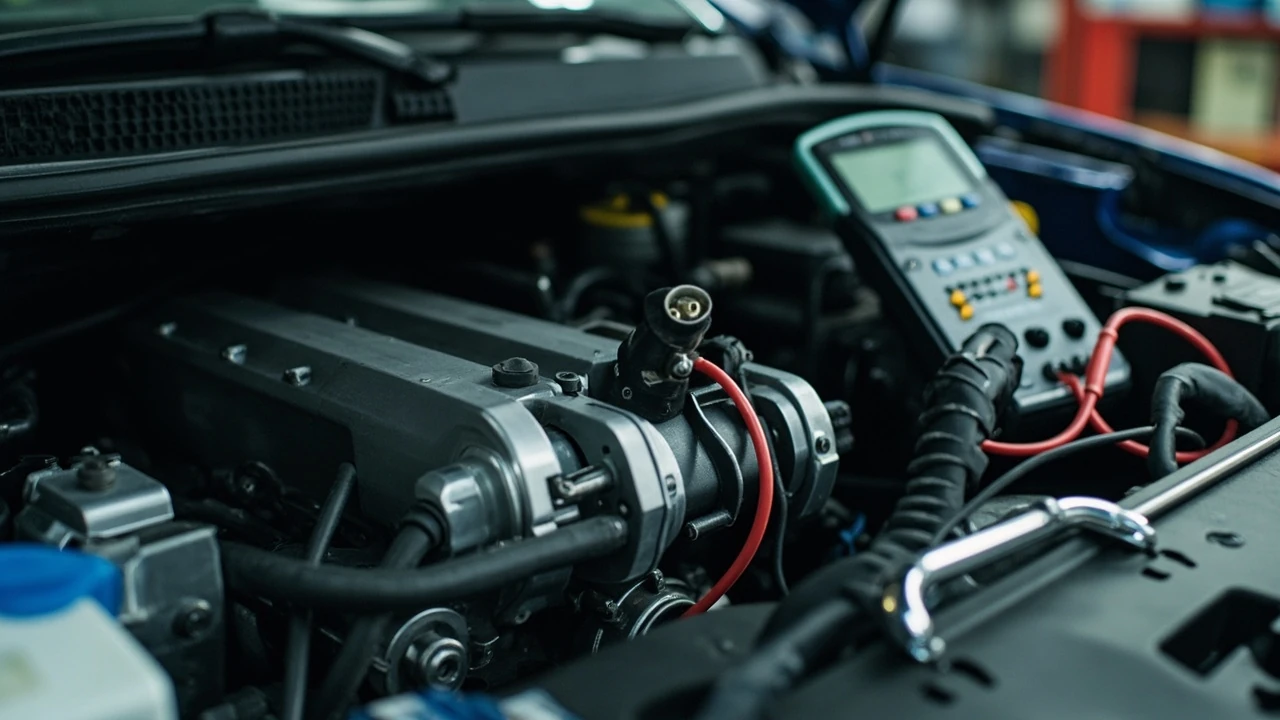
How to tell if starter is bad: use the symptoms to narrow it down
A starter that fails with a weak click, grinds, or refuses to engage can resemble a dead battery, a bad ignition switch, or a seized engine. Knowing how to tell if starter is bad starts with separating an electrical no-start from a mechanical failure. Listen closely to what happens when you turn the key, confirm the battery state, and check whether the starter receives the signal it needs before condemning the unit.
The starter motor is responsible for engaging the flywheel and turning the engine fast enough to start. Its solenoid controls the high-current path to the motor, while the motor drives the pinion gear into the ring gear. A fault in either part can stop the engine, but the sound and electrical behavior often reveal where the problem lies.
Most diagnostics should begin with simple checks. Avoid replacing a starter until the battery, connections, fuses, neutral or clutch safety switch, and control circuit have been ruled out. That prevents spending money on a motor that was never receiving the correct signal.
What a failing starter usually sounds and feels like
No-start symptoms are more useful when you separate them into categories. A starter that spins without engaging, makes a grinding sound, or never makes any sound at all may have different causes. The key is to note what happens with the key in the start position and compare it with what happens when you release the key.
| Symptom | What the driver may notice | Likely area to investigate |
|---|---|---|
| Rapid clicking | The starter clicks quickly but the engine does not crank. | Battery voltage, terminal condition, ground, or a high-resistance connection |
| Single click | The starter clicks once and stops, or the solenoid engages without sustained motor rotation. | Solenoid, starter motor, wiring, or insufficient voltage |
| Grinding noise | The starter rotates loudly but does not move the engine. | Starter drive, flywheel ring gear, or excessive starter-to-engine clearance |
| Whine that fades | The starter spins rapidly, then slows or stops as the key is released. | Starter motor, engine seizure, or low system voltage |
| Slow crank | The engine turns sluggishly, especially on a cold morning. | Battery condition, terminal corrosion, or a weak starter motor |
| No sound at all | Nothing happens when the driver operates the starter. | Starter control circuit, fuse, ignition switch, safety interlock, or starter assembly |
| Engine cranks but will not fire | The engine rotates normally without starting. | Fuel, spark, compression, or engine management—not the starter |
Temperature, battery charge, and repeatability matter. A starter that works only when the engine is warm may point to a battery, charging-system, or high-resistance connection problem rather than a defective starter. A sound that occurs every time under the same conditions is easier to diagnose than an intermittent problem that happens only when the vehicle is cold or damp.
Also record whether the engine has been recently serviced. A dropped oil pan, coolant intrusion, incorrect belt installation, or work near the starter can create a new starting complaint without making the starter itself defective.
Distinguish a starter problem from other no-start causes
The starter cannot turn the engine if it does not receive battery power, if its control circuit does not activate the solenoid, or if the motor cannot mechanically engage the flywheel. That means “the car does not start” is not enough to diagnose a bad starter.
- The engine cranks normally but does not run: the starter has already completed its main job. Troubleshoot fuel delivery, ignition, compression, or engine controls.
- The engine turns slowly: check battery charge and cable connections before testing the starter under load.
- The starter only clicks: determine whether the click comes from the solenoid and whether voltage remains high while the motor attempts to run.
- The starter spins without engaging: look for a damaged drive or an incompatible/misaligned starter, but also inspect the flywheel ring gear.
- Nothing operates the starter: test the starter fuse, control wiring, ignition switch, and transmission or clutch interlock before condemning the starter.
For more help distinguishing a click from other starting noises, use this guide to car clicks when trying to start. It is especially useful when the starter has clearly energized but the engine does not move.
One important example of how a title can be more dramatic than the underlying facts comes from the country song Tell Me Something Bad About Tulsa, which the source identifies as a song written by Red Lane. Similarly, a frightening starter noise is only one clue. The vehicle’s electrical behavior and mechanical symptoms determine whether the starter deserves blame.
Complete the preliminary checks before testing the starter
Before removing or electrically testing a starter, establish that the rest of the starting system is supplying the expected conditions. This stage takes less time than replacing the motor and can reveal the actual fault.
Check the battery and its connections
A fully charged, properly connected battery provides the electrical foundation for the starter. Inspect the terminals for corrosion, looseness, heat damage, or a cable that is frayed beneath the insulation. Tighten a loose connection by hand and clean corrosion with an approved battery cleaner. Do not pry the battery terminals with the ignition on, and avoid letting tools bridge the positive and negative terminals.
Measure battery voltage with the engine off. A rested, fully charged battery commonly sits around 12.6 volts, although the reading depends on battery type, age, temperature, and state of charge. During cranking, voltage should remain reasonably high. If it collapses into the single digits, the battery may be discharged, sulfated, or unable to support the starter’s load. For more detail on expected readings, see how many volts should a car battery have.
Inspect the starter fuse and wiring
Check the vehicle’s fuse-box diagram rather than replacing random fuses or replacing the starter. Look for blown or loose fuses, damaged wiring, corroded connectors, and a starter relay that does not transfer power. The exact fuse location and circuit design vary by model, so use the correct diagram for the vehicle.
Confirm the transmission or clutch safety switch
Automatic-transmission vehicles normally require the shifter in Park or Neutral. Manual-transmission vehicles often have a clutch pedal position switch that prevents starter engagement. A damaged switch, incorrect linkage, or misadjusted pedal can create the same symptom as a failed starter. Confirm that the vehicle responds correctly to the shift or clutch instruction before testing the motor.
Review recent service and mechanical conditions
Listen for internal engine noises during cranking. A starter may engage and spin normally while the engine is mechanically locked. A failed water pump, seized accessory, bent piston, or other internal damage can stop rotation even with a healthy starter. If the starter free-spins but the engine will not rotate, the diagnosis needs to shift toward mechanical engagement rather than a simple electrical test.
Use a controlled electrical test to verify starter operation
If the battery, fuses, connections, and safety interlocks appear sound, a controlled test can show whether the starter receives power and whether the motor draws a usable current. The exact procedure depends on the vehicle’s starting system, and some manufacturers place the starter relay inside the fuse box or control module rather than on the starter itself.
Basic automotive starting systems commonly use one of two arrangements. In a direct-control system, the starter solenoid receives a low-current signal and routes battery power directly to the motor. In a computer-controlled system, a relay or control module supplies the high-current connection. Knowing which arrangement your vehicle uses prevents confusing a control signal with full battery voltage at the motor.
Test for voltage at the solenoid
With the transmission in the correct safe position and the ignition commanded to start, back-probe the starter’s input terminal as the driver operates the starter. The wire should show voltage when the relay closes. If the solenoid never receives voltage, the fault is upstream in the switch, interlock, fuse, relay, control module, wiring, or connector. Replacing the starter at that point would not fix the problem.
Test for voltage at the motor output
On many vehicles, the solenoid’s large terminal is connected to the motor. When the solenoid engages, battery voltage should appear at that connection. If the input receives voltage but the output does not, the solenoid or its internal contacts may be defective.
Measure current draw during engagement
A clamp meter around the starter cable can show whether the motor draws current while engaging. An excessively high reading can indicate a seized or damaged starter motor. A reading near zero, despite correct voltage at the motor, can indicate an open motor winding or failed motor. Low current with a weak crank may indicate a low-voltage condition, although the test setup and vehicle design affect interpretation.
Never hold a high-current starter cable with a wrench, improvise a jumper across heavy battery cables, or defeat the safety interlock on an automatic transmission. If the vehicle starts when a temporary bypass is used, that does not make the bypass safe. It is a diagnostic finding that points to a control circuit, not an instruction to drive the vehicle in that state.
Read the results: what each test outcome means
Electrical findings become meaningful when you combine them with the noise and the engine’s response. No single reading should override the complete pattern.
| Test result | Most likely interpretation | Next check |
|---|---|---|
| No voltage at the starter input | The starter is not being commanded or is not receiving switched power. | Check the fuse, ignition switch, interlock, relay, module, connectors, and wiring |
| Input voltage present, but no voltage at the motor output | The solenoid contacts may have failed. | Confirm terminal layout and test the starter assembly according to the service information |
| Full voltage at the motor, but the motor does not turn | Open or damaged motor windings, broken brushes, or a defective motor assembly. | Perform the manufacturer-specified starter tests or have the unit bench-tested |
| The motor spins but cannot engage the flywheel | Damaged drive, missing teeth, incorrect clearance, or flywheel damage. | Inspect the starter drive and ring gear |
| Very high current draw | The starter motor is seized, mechanically damaged, or jammed against the ring gear. | Remove and inspect the starter; also inspect the flywheel area |
| Weak current draw and slow crank | Low system voltage or a weak starter motor. | Repeat battery, charging-system, ground, and cable checks under load |
| Normal crank but no engine start | The starter is functioning sufficiently to turn the engine. | Move to fuel, ignition, compression, and engine-management diagnosis |
Interpretation should remain conservative. Some starters engage in a way that makes the current measurement less obvious, and electronic starting systems may not behave like older vehicles with conventional solenoid wiring. A scan tool can reveal commanded starter requests, crank-position signals, and communication errors, but it does not replace physical voltage and load checks.
A starter can also appear faulty when the engine stalls immediately after starting. Rough idle, low oil pressure warnings, check-engine lights, or a fuel-related code should be addressed separately. Those conditions may occur while cranking and make the starter sound less smooth, but the root cause may be fuel delivery, ignition, or an engine-management fault.
Separate starter motor, solenoid, and drive failures
The starter assembly contains several parts that can fail independently. Identifying the failed component can affect the repair, especially on vehicles with a new or rebuilt starter sold without the original drive or solenoid.
- Solenoid failure: the click occurs, but the motor receives no sustained power. On some designs, voltage may be present at the input but absent at the motor output.
- Armature or field winding failure: the solenoid engages and voltage reaches the motor, but the motor does not rotate or cannot develop normal speed.
- Brush or commutator wear: the motor may start intermittently, work only when warm, or grind under load.
- Drive or pinion damage: the motor spins without transferring motion to the flywheel. Missing teeth on the starter drive or flywheel ring gear can cause a sharp clunk.
- Bearing or nose failure: the starter may produce a rubbing or scraping sound, and the damaged drive may not align correctly with the ring gear.
A grinding starter is not automatically proof that the motor is ruined. The sound can come from a damaged ring gear even when the starter is new. Conversely, a starter can fail without making a dramatic noise if its windings open. This is why replacing a unit based on sound alone can lead to a repeat repair.
If the vehicle has high mileage, has a known electrical history, or the starter is already been replaced more than once, inspect the wiring carefully. A shorted starter cable can damage the solenoid or charging-system wiring, and a repeated failure may indicate a poor ground, an incorrect alternator output, or an aftermarket unit with an unsuitable motor.
Decide whether the starter should be repaired or replaced
A bad starter often receives a replacement assembly because the motor, solenoid, and drive are commonly serviced together. That can be economical when the vehicle is older, labor is the main cost, or the replacement part is readily available. However, replacement does not eliminate the need to correct the cause. A shorted cable, failed relay, or battery problem can damage the new starter too.
Consider the following when deciding on a repair path:
- Confirm the diagnosis: make sure the original symptom has been reproduced and the battery, interlocks, fuse, relay, and control wiring are sound.
- Inspect the flywheel area: remove the starter when possible so the drive and ring gear can be viewed and checked for damage.
- Compare parts: verify that the replacement starter has the correct motor output, solenoid configuration, pinion style, and mounting arrangement for the vehicle.
- Address electrical faults: replace damaged terminals, corroded cables, grounds, relays, or fusible links rather than hiding the symptom with a new motor.
- Plan the labor: access varies considerably by vehicle. A starter on an engine with substantial intake or exhaust components may take longer to reach than one on an otherwise open engine bay.
Repairing the starter can be practical when the motor and drive are serviceable and the correct procedures are followed. Rebuilding an assembly without understanding its design can lead to incorrect pinion clearance, poor grounding, or a mismatch between the motor and solenoid. For a do-it-yourself vehicle owner, the greater risk often comes from working around the high-current cables and bypassing controls incorrectly, not from the replacement part itself.
After installation, verify several operating details. The engine should crank consistently, the starter should disengage promptly when the key returns to run, and the charging system should restore battery voltage. Recheck for abnormal noises after the first successful starts. If the starter remains noisy, the engine does not start promptly, or the battery discharges during short trips, continue diagnosing rather than assuming the replacement solved every issue.
Frequently asked questions
How can I tell if the starter is bad without removing it?
Listen and record what happens during the start attempt, then verify the battery and connections. A one-time click, rapid clicking, slow crank, spinning without engagement, or no response can narrow the fault. Voltage checks at the starter terminals and a current reading can confirm whether the starter receives power and attempts to operate. Removing the unit is not always necessary for initial diagnosis.
Does a clicking sound always mean the starter is bad?
No. Rapid clicking often points to low battery voltage or a high-resistance connection, while a single click can come from a failed solenoid, a weak motor, or a control-circuit problem. Check the battery under load and inspect the terminals before replacing the starter.
What does it mean if the starter spins but the engine does not start?
If the engine does not crank at all, the starter may not be engaging the flywheel. A damaged pinion, missing teeth, incorrect alignment, or flywheel ring-gear damage can cause this. If the engine does crank but simply will not fire, the starter is working and the problem lies elsewhere.
Can a bad alternator damage the starter?
Yes. A charging-system problem can expose the starter to voltage outside its normal operating range. The connection is less direct than a bad battery, but unusually high charging voltage can damage electrical components, while inadequate voltage can make the starter operate poorly. Diagnose the charging system whenever a starter failure accompanies other electrical complaints.
Why does my starter work only when the engine is warm?
Cold operation can increase the load on the battery and starter motor. A weak starter, aged battery, corroded connection, or marginal ground may work after warming. Heat-related starter winding or solenoid faults are also possible. Compare battery voltage and cranking current when cold and warm rather than immediately replacing the starter.
How long should a starter motor turn during one attempt?
A brief crank is normal, but the starter should not continue running after the engine starts or after the key is released. Continued running can indicate an ignition-switch or control-system problem. If the starter never disengages, shut off the engine and diagnose the switch, relay, and wiring to prevent damage.
Is it safe to jump-start a car with a clicking starter?
A jump start can help only if the vehicle’s own battery is discharged enough to prevent the starter from receiving adequate power. It will not correct a failed starter, damaged cable, or defective control circuit. Follow the correct connection and removal sequence, and do not connect a booster cable to an open battery terminal or damaged post.
Can a bad ignition switch cause a starter to click?
Yes. The ignition switch sends the start command through the vehicle’s starter control circuit. If it fails open, the starter may not receive a signal. If it fails shorted, it can keep the starter engaged after the key is released. Testing the input signal at the starter relay or solenoid helps separate a switch and wiring problem from a starter failure.
How much starter current should I measure?
There is no single universal figure because motor design, engine displacement, battery condition, and test conditions affect the reading. A seized starter generally draws unusually high current, while an open winding may draw little or none. Compare the result with manufacturer information for the vehicle and with the battery voltage present during the test.
What should I check after replacing the starter?
Confirm that the engine cranks consistently, the starter disengages immediately after starting, and the battery voltage recovers during operation. Listen for new grinding or scraping sounds and recheck cable connections. If the starter continues clicking, spinning without engaging, or running with the key released, return to the control circuit, battery, or flywheel diagnosis rather than replacing the new unit again.



Leave a Reply